Blog Posts

Posted in #Anthology

Portland Noir

Explore the dark, rainy underbelly of one of America’s most beautiful but enigmatic cities.

Akashic Books continues its groundbreaking series of original noir anthologies, launched in 2004 with Brooklyn Noir. Each story is set in a distinct neighborhood or location within the city of the book.

Brand-new stories by: Gigi Little, Justin Hocking, Christopher Bolton, Jess Walter, Monica Drake, Jamie S. Rich (illustrated by Joëlle Jones), Dan DeWeese, Zoe Trope, Luciana Lopez, Karen Karbo, Bill Cameron, Ariel Gore, Floyd Skloot, Megan Kruse, Kimberly Warner-Cohen, and Jonathan Selwood.

From the introduction by Kevin Sampsell:

“Settled in 1843 and named by a coin flip (we were almost named Boston), Portland had troubles from the start. The first sheriff, William Johnson, was busted for selling ‘ardent spirits.’ He had been ‘reduced by an evil heart,’ said the indictment. The first couple of decades were probably pretty rough, what with the constant flooding and muddy streets making all the citizens cranky . . . Later, in the 1940s and ’50s, the city practically thrived on criminal activity. Speakeasies, brothels, and gambling dens popped up across the downtown area . . . Portland became known as quite the decadent town, even prompting Bobby Kennedy to wrangle up its main bad guys for a televised Racketeering Committee meeting in 1957. One senator said at the hearings, ‘If I lived there, I would suggest they pull the flags down to half-mast in public shame.’

A lot of these places of ‘shame’ remain standing, and while many are occupied now by salons and offices, some of them are probably still home to gambling and stripping. (Portland does, after all, have more strip clubs per capita than any other city in America—and yep, they take it all off here.) . . . Portland continues to update its own version of a contemporary utopian society as more and more people flock here. But even in utopia, crime and unrest are always bubbling right under the surface.”


Ed Battistella

5 out of 5 stars

Gritty Portland

Reviewed in the United States on July 4, 2014

Format: Paperback

In Portland Noir, editor Kevin Sampsell takes us through the Rose City’s wilted flowers with 16 stories by Oregonians including one illustrated story and another set in Powell’s City of Books. Some of my favorite Oregon writers were represented including Bill Cameron, Flood Skloot, Karen Karbo and Monica Drake, and I was introduced to some new-to-me folks—like Gigi Little, Justin Hocking, Zoe Trope, and Luciana Lopez. Great crime fiction, gritty local color, an edge depiction of the seamy side of present dya Portland and a fine tribute to Portland’s noirish history.


Posted in #BookTours

Dark Ugly Places


Some wounds don’t heal. They take over.

A Beverly Hills psychological thriller about grief, female rage, fractured identity, and revenge.


Dark Ugly Places

by Ashley Mansour

Genre: Psychological Thriller, Domestic Suspense


Some wounds don’t heal. They fester. They whisper. They take over.

In Dark Ugly Places, trauma isn’t something you survive — it’s something that survives you.

Thirty-four-year-old Nicola Holiday loses everything in a hit-and-run: her husband dead, her body broken, her fourteen-year-old daughter Emmy forever changed. With no one held accountable, she spirals into grief, panic attacks, and financial ruin — awakening a hereditary darkness she’s spent her life trying to outrun.

That darkness has a voice now. Her name is Martha, and she aches for revenge.

As Nicola’s grip on reality loosens, Martha slips into another life — one of wealth, glamour, and moral rot. When she crosses paths with the wife of a famous actor, Nicola’s suspicions ignite.

Pulled between vengeance and annihilation, Nicola and Martha collide with a woman whose secrets may be the key to everything — or the thing that destroys them both.

Dark, provocative, and deeply unsettling — a haunting psychological portrait of female rage, obsession, and the terrifying lengths the mind will go to survive unbearable pain.

Because sometimes the most dangerous place isn’t the past. It’s inside your own head.


“A suspenseful and relentless tale of troubled Californians.”

– Kirkus Reviews


“A tense, viciously readable psychological thriller about the violence that lurks beneath polished surfaces.”

 – BookLife Reviews


“With fast-paced thrills and gripping psychological drama, Ashley Mansour’s Dark Ugly Places serves up vengeance for morally complex characters.” – Indiereader


**Releases September 15 – PreOrder Now!**

Amazon * Author’s Site * Apple * B&N * Google * Kobo * Bookshop.org * Bookbub * Goodreads


PROLOGUE

No one likes to be kept in the dark.

In the dark, everything is murky, even the Los Angeles sky.

But the day of Nicola’s accident, I had a pretty clear view of things. It tends to be that way—clear—when Nicola isn’t.

Nicola, Ben, and their daughter, Emmy, were walking holding hands, something the three of them hadn’t done since Emmy was a little kid. I felt the itch in Nicola’s palm, like she didn’t want to hold hands. But Emmy insisted. She was between them, arms outstretched, making that little humming sound she sometimes made when she was nervous or lost in thought. Ben walked on slightly ahead, his head down, eyes focused on the phone in his hand. I could almost hear his teeth grinding.

Up ahead, the road was clear. The sun covered everything in butter-yellow light. Crows perched in the bare-barked trees and made long, scratchy cries like a group of smokers laughing. They rustled leaves and crossed the pavement before them. But the trees were still, like the air had been sucked out of the city. Up ahead, the road was clear.

The three of them approached the corner, Emmy and Nicola chatting aimlessly. Ben narrowed his eyes and squinted at the screen as if the sky was too bright. He stepped out into the road first. Emmy, next. She skipped slightly—braids flying—and pulled her mom’s arm.

Nicola looked up and saw one of the crows overhead, its beak open, making a dreadful sound. When she looked back at the road, her gut pinged with a horrible dread she couldn’t place.

Then she—we—saw it.

From the middle distance, something large and hurtled into view, its body glinting in the sun. Emmy screamed. Nicola tried to pull her back, but one by one, her fingers slipped out of her grasp.

It was too late.

Nicola’s body collided with the big, thing, and in the next moment, she was airborne, tumbling through the air as if she had been taken by a tornado. Her thoughts spiraled with her, spinning out of control.

I’m going to die.

I’m going to live.

Don’t let me die.

I’m going to die.

She kept spiraling, around and around, until I stopped her with a simple suggestion: Breathe, Nicola. Breathe. We have this power, those of us who live in the darkness.

The asphalt grated her spine. It must have hurt, but Nicola did not cry. Perhaps because the air was too full of Emmy’s screams.

She rolled to her left, her left arm pinned against her chest like a piece of limp fabric. Her left leg lay stretched out before her perfectly straight, but dead. Cold. Frozen in place. She rolled to her side and saw Emmy, blood coating half of her face as though she were wearing a mask. Five feet away, Ben lay in the road unmoving, his body contorted, his face turned away.

Overhead, the stretch of blue sky angled down Beverly Boulevard and went on forever. Cars passed, some honking, others slowing to stop and help or to get a better look. Nicola grunted and heaved herself along the ground, her jaw gritting with pain. She reached for Emmy, reached for Ben.

The body of the car stirred. A door opened. A black polished shoe emerged onto the asphalt as the driver leaned out, then disappeared again as the door shut. I heard the engine as the car started and rolled backwards, slow at first, then picking up speed until it was gone.


Ashley Mansour writes dark, cinematic psychological suspense and domestic suspense about dangerous relationships, buried truths, and the chaos waiting beneath the surface of ordinary lives.

Posted in Guest Authors

How Retirees Can Find and Buy the Perfect Homestead-Friendly Home

For retirees buying bigger homes, the pull is easy to understand: room for a homesteading lifestyle, space for homesteading hobbies, and a place that makes welcoming family visits feel natural instead of cramped. The tension is that the same extra square footage and land that promise freedom can also raise hard questions about retirement housing needs like money, maintenance, and mobility. Many retirees want a home that supports growing food, keeping a few animals, or just having a workshop, without turning every day into a to-do list. With the right approach, that bigger-home dream can stay practical.

Turn Your Homestead Dream Into a Smart Home Offer

This process helps you go from “We want land and space” to a short list of homes you can truly afford, maintain, and enjoy. It matters because in retirement, the wrong square footage or acreage can quietly turn into a monthly budget strain or a daily workload.

  1. Set a retirement-safe budget (with wiggle room)
    Start with your monthly comfort number, not the lender’s maximum, and include taxes, insurance, utilities, and a maintenance cushion. If you will still be traveling, helping family, or living on a fixed income, bake those realities into the budget now. This keeps the “bigger home” idea from pushing you into a tighter lifestyle than you want.
  2. Define your non-negotiables for land and layout
    Write down what you will actually do on the property in the next 12 months: garden beds, a small flock, a workshop, or just privacy and storage. Then translate that into practical requirements like a single-level primary suite, manageable driveway, and enough flat ground for the projects you will really maintain. This turns endless browsing into targeted searching.
  3. Screen listings for rules and future surprises
    Before you fall in love with photos, check whether the area supports the lifestyle you want, such as animals, outbuildings, or home-based activity. Your county often publishes zoning maps that help you spot nearby uses that could affect noise, traffic, or long-term privacy. This step saves time and prevents costly pivots after you are emotionally invested.
  4. Walk the property like an owner, not a visitor
    During showings, test the day-to-day realities: stairs, door widths, heating and cooling feel, and where you would carry groceries, tools, or feed. Outside, look for drainage issues, sun exposure for growing, and how far water and power would need to run for a shed or greenhouse. Ask early about legal details such as mineral rights so you understand what you are truly buying.
  5. Compare true costs, then offer with clear guardrails
    Create a simple side-by-side sheet for your top two or three homes that includes estimated utilities, insurance, property taxes, commute or travel access, and the first-year “make it usable” list. Then make an offer that protects you with the timelines and contingencies you need, while staying inside your comfort budget. The goal is a home you can settle into, not a project that immediately takes over.

When a Homesteading Hobby Becomes a Small Business: What Changes

Once you’ve made a smart offer on a home that fits your homesteading goals, it’s worth thinking about what happens if that “just for fun” project starts bringing in real money. When a homesteading hobby becomes a business, the big shift is treating it like a real venture: you do a bit of simple planning, get clearer on day-to-day operations (making, packaging, tracking orders), and think about basic marketing so people can actually find what you sell. If you want to strengthen those muscles, earning a business management degree can build your skills in leadership, operations, and project management, here’s a neat breakdown of what that can cover. And because online degree programs exist, it can be easier to keep your business moving while you stay on top of your coursework.

Use This Home Feature Checklist for Land, Layout, and Family Space

When I look at homes through a homesteading lens, I’m not hunting for “perfect.” I’m trying to avoid the kind of perfection that makes daily life harder, especially when grandkids pile in or a hobby starts acting like a small business.

  1. Start with a realistic land target (and walk it): Decide what you actually want to do, garden beds, a few fruit trees, small livestock, beekeeping, then match land to that list. A common rule of thumb is five to ten acres for a homestead, but plenty of retirees do great on less if the soil is good and the layout is efficient. When you tour, walk the whole property: notice slope, soggy spots, sun exposure, and where you’d put a garden without carrying tools a quarter mile.
  2. Choose a “work triangle” between house, storage, and water/power: Homesteading gets old fast when every chore involves five trips back to the garage. Look for a setup where a shed/workshop, outdoor spigot, and an exterior door are close together, ideally with a hard path you can roll a cart on. If you think you might sell eggs, jam, seedlings, or crafts someday, this also supports smoother “operations” without turning your kitchen into a shipping department.
  3. Claim a real workshop zone (not just a corner of the garage): Even a modest hobby needs a safe, organized space, workbench, good lighting, enough outlets, and the ability to make noise or dust without upsetting the whole house. I like properties with a detached shop, a garage bay you can close off, or a basement area with proper ventilation. If you’re thinking small-business someday, picture where inventory lives and where packing happens so it doesn’t take over the dining table.
  4. Prioritize storage that’s boring but life-changing: Look for a mudroom, pantry, and a place for “messy gear” near an entry: boots, buckets, canning jars, pet food, feed bins. Ask yourself, “Where would I store 6–12 months of supplies?” and “Where do bulk items go?” A home with deep closets and reachable shelving will beat a bigger house with nowhere practical to put things.
  5. Plan flexible family space: playroom now, guest-ready later: Extra rooms earn their keep when they can change roles, playroom when the kids visit, hobby room when they don’t, occasional bedroom when someone stays over. Look for a room near a bathroom, with a door you can close and durable flooring you won’t worry about. If you host often, an open kitchen-to-living flow matters more than a formal dining room you’ll use twice a year.
  6. Make accessibility a quiet requirement, not an afterthought: Favor single-level living, wider hallways, minimal steps at entrances, and a bathroom you could add grab bars to without remodeling the whole wall. Check lighting, handrails, and how slippery the outdoor paths feel when wet. You’re buying a place for hobbies, yes, but also for the version of you that wants fewer ladders and less risk.

Homestead-Ready Retirement Home FAQs

Q: How can I tell if a homestead-friendly home is actually affordable long-term?
A: I look past the mortgage and price out the “quiet costs” like heating, driveway care, well or septic service, and insurance. Ask for 12 months of utility bills and a list of recent repairs, then build a simple monthly buffer for surprises. If cash flow is tight, consider whether downsizing the land or outbuildings gives you the lifestyle without the stress.

Q: What upkeep tends to surprise retirees on bigger properties?
A: Mowing, tree work, drainage issues, and long private roads can become regular line items. Before you buy, get quotes for the tasks you will not do yourself and confirm local contractors will service the address. A smaller, well-laid-out parcel can feel “bigger” than acreage you can’t comfortably manage.

Q: How do I avoid zoning headaches for animals, gardens, or a small home business?
A: Call the county or town planning office and ask what the property is zoned for, plus any limits on livestock, accessory buildings, and on-site sales. Request the rules in writing and verify what permits are required for sheds, fencing, or a farm stand. When in doubt, write your “must have” uses down and confirm each one before you offer.

Q: Can a reverse mortgage help me buy in retirement?
A: Sometimes, but it is specific to age and eligibility, and it is not a fit for every budget. A reverse mortgage loan is available to qualifying buyers who are 62 or older. Talk with a trusted lender and a HUD-approved counselor so you understand fees, responsibilities, and what happens long-term.

Q: How should I plan to use extra rooms so they don’t just collect clutter?
A: Give each room a “job” and a backup job, like guest space that converts to crafting or a grandkid playroom that becomes an office. Choose durable flooring, add closed storage, and keep one wall flexible for shelving or a fold-down table. If a room can’t earn its keep in two roles, you may not need it.

Choose a Homestead-Friendly Home That Fits Your Retirement Life

Retirement can feel like a tug-of-war between wanting more space and worrying about cost, upkeep, and whether the land will actually work. The steadier path is treating the search as a values-first match: pick a place that supports the life wanted, projects, comfort, and connection, without pretending every day will be effortless. Done well, the benefits of homesteading homes show up in family-centered living, homesteading home satisfaction, and a quieter kind of retirement lifestyle optimism that grows with time. Buy the home that supports your days, not the one that only looks good on paper.

Posted in #BookTours

The Champagne Crush Audiobook

The Champagne Crush
Caroline O’ Connell
(Les Femmes Series)
Publication date: August 20th 2026
Genres: Adult, Contemporary, Romance

Perfect for fans of Emily in Paris—with the sophistication of the wine world and a slow-burn, opposites-attract love story. A glitzy PR expert and a traditional wine president clash on a high-stakes global launch—where rivalry, reinvention, and romance collide.

AUDIOBOOK PRODUCTION DETAILS:

  • Format: Unabridged Audiobook
  • Performance: Single Narration by acclaimed British stage actress Karen Gundersen
  • Audio Features: Fully voiced character accents and deep emotional range
  • Primary Tropes: Workplace Romance, Opposites Attract, Slow-Burn
  • Audiobook Vibe: High-tension with a romantic, high-heat fade-to-black intimacy level (the intense build-up is on the page, but the camera pulls away before explicit details)

Goodreads / Amazon / BookBub

EXCERPT:

Chris McDermott’s Family Ranch in Napa, CA
(Dinner after an all-day TV shoot in the vineyards)

When they were finishing the fig tart dessert with freshly whipped cream from their dairy, his dad leaned over to Chris. “Why don’t you show Catherine our current operation? It’s not much yet, but she’ll be able to say she saw a world class winery in its early stages.” He stood up and grabbed his plate. “I’ll help Maura clear the dishes. You two can take off.”

Chris didn’t need prompting. He was feeling inexplicably drawn to Catherine. The temperature outside dropped quickly, so he bundled her up in one of his warm leather jackets. It was three sizes too big, which only made her look more adorable.

They stepped onto a moonlit path and walked a short distance to the temporary winery: an aluminum-sided structure that held rudimentary winemaking equipment next to cases of empty bottles. A walk-in cooler held samples of the wines they’d already produced laid horizontally on racks. On the far end of the room, a partial wall separated the “office”—an old metal desk, a long table with office equipment and a computer, one file cabinet, shelves brimming with books and magazines, and a large bulletin board with articles and graphs clipped on it.

“I know it doesn’t look like much yet,” Chris said. “But it’s the genesis of our dream. My dad and I have been working toward this moment for many years, the chance to create our own family wine.”

He held out his hand. “Let’s go sit outside. It’s such a clear night, we should be able to see the stars.”

They sat on hay bales near the barn, and he wrapped his arm around her shoulders to keep her warm. He pointed up to the sky. “Most nights you can see the constellations and major stars, unless there’s cloud cover.” He pulled her closer. “There’s Venus . . .”

“Named after the Roman goddess of love and beauty . . .” Catherine chimed in.

Seems the beauty is right here, sitting next to me. “How about you, Catherine Reynolds? What are your dreams?”

She tucked her hands into the jacket pockets. “Unlike you, my dreams have changed over time. When Vanessa and I were teenagers, we went into modeling.” She made a face. “It’s not as glamorous as people think. Now, I’d like to pursue a career in the hospitality sector.” She sighed. “Still working that out.”

“I’m sorry I doubted you in the beginning. I think you’re a wonderful asset to the company.” And to my life.

He stood up and silently offered his hand, pulling her up to face him. An owl hooted nearby, momentarily jarring him from his intent to steal a kiss. He took a deep breath and gazed into her upturned face. Her long-lashed eyes blinked as she looked into his questioningly.

“We’d better get going.” He turned her around and draped his arm over her shoulders as they walked back. When they reached the guest cottage, he gave her a warm hug and walked off. She’s too appealing. I’m falling fast.

Author Bio:

Caroline O’Connell is the author of numerous travel guides, including Affordable Paris Hotels. The Champagne Crush is the first novel in the Les Femmes Series. In conjunction with the launch of the audiobook version, the ebook is discounted to $1.99 (from $9.99) on all platforms. Her website is https://carolinestraveltips.com/.


GIVEAWAY!

The Champagne Crush Blitz


Posted in #BookTours

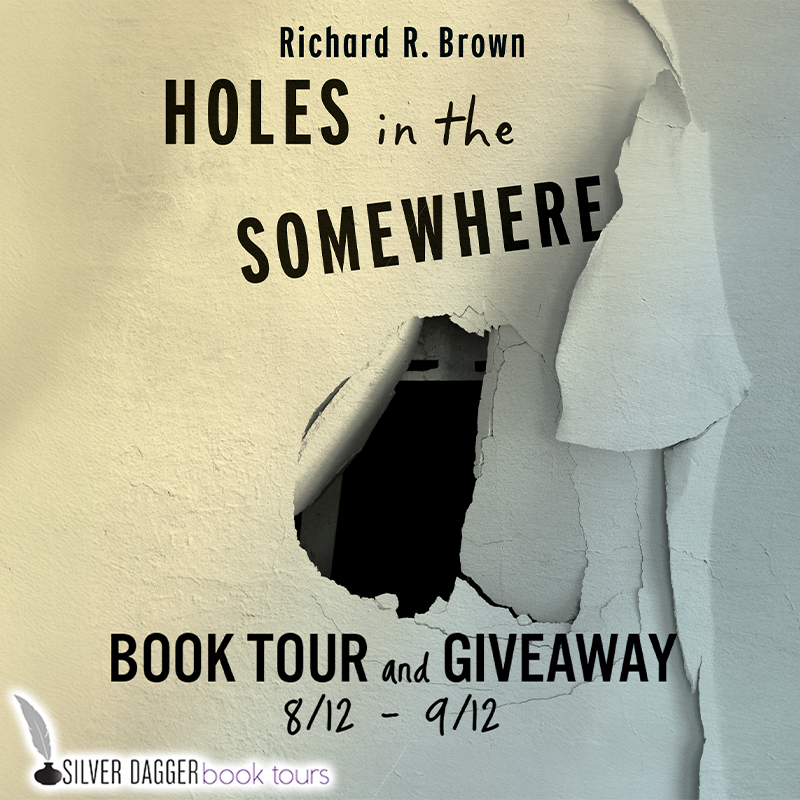
Holes in the Somewhere


Sometimes grief sneaks up on you and hunts you down.

Sometimes it walks right up and punches you.


Holes in the Somewhere 

by Richard R. Brown

Genre: Speculative Fiction, Horror Stories


Holes In The Somewhere is a collection of short works, anchored by a personal memoir of the author’s own experience with grief and loss after the passing of his father from cancer, by speculative fiction author Richard R. Brown.

A single mother encounters insanity in the worst possible person; an estranged parent loses his reunited family to a mysterious bathroom wall; a group of strangers come together to fight a fungal pandemic; college students prepare for the extinction of the Sun… these are a few of the challenges faced by the desperate characters in Holes In The Somewhere. The choices they make, the dilemmas they wrestle with, all have very supernatural consequences, but are felt with very human emotions.

These stories will tug at strings your heart thought were too well-hidden for anyone to know about, and cause the mind to probe the gray areas between wrong and right. Between normal and paranormal. Behind what’s real and only to the side of what’s unreal. A perfect mix of quick, unsettling reads, and longer, heart-wrenching escapes.


What readers are saying:

“The debut is speculative fiction in form: weird, unsettling, occasionally cosmic. But it reads less like a genre exercise than like grief that has been given permission to take unusual shapes.” – Justine Castellon, Author/Reviewer

“I guarantee there is a ‘gotcha’ story in there for just about anybody, and if you don’t find at least one that bothers you just as you’re about to fall asleep, you’re made of sterner stuff than I am.” – Kenneth Crist, editor-in-chief, Black Petals Magazine

“These stories are weird and creepy and heart-wrenching in all the best ways. If you enjoy fiction that makes you question everything and wrecks you emotionally, this is for you!” – Valerie S., 5 star Amazon Review


Amazon * B&N * Kobo * IngramSpark * Bookbub * Goodreads


Excerpt from ‘A Hole In The Somewhere’, a story in ‘Holes In The Somewhere’


When he hung up, he saw the answer to his problem of Tony’s dead body. He picked Tony up and wrestled him into the wall where the blurred patch was. Pieces seemed to fall off into the wall, but that just made Tony easier to handle. He just had time to change into a clean shirt and slide the gun back under the couch before there came a soft knock on his door.

Jack wiped sweat from his forehead and opened the door. Before him stood the same little girl who held his hand twenty years ago and asked him, “Why, Daddy?” about absolutely everything. Only now she had green eyes when she used to have brown eyes. 

“Mommy says you’re my grandpa,” she said to him now. “Why is your door all bubbly and brown, Grandpa?”

Jack looked up and past his granddaughter at Mary, who was smiling anxiously at both of them.

“Hi, Daddy,” was all she said. It was enough.

Jack burst into tears, picked his granddaughter up in his left arm, and trotted down the steps to embrace his daughter with his right arm. They hugged for several moments before a muffled, “Why are you crying, Grandpa?” came from his shoulder.

Jack laughed, and put her down on the ground again. “I’m crying because I’m so happy to meet you!” he said.

“Oh. My name’s Emily, but you can call me Emmy. Why do you live by the train tracks, Grandpa?”

“Actually, Dad, I’m curious, too. This address came up as ‘Condemned.’ How is it that you live here?” 

Jack led them inside and told them his story, forcing himself to be honest about his decisions and his reasons. Recent events disappeared from his awareness as the last twenty years enveloped him. He told them about his depression and anger from the divorce, and how losing everything seduced him into giving up everything. He hadn’t wanted to try to replace what he had lost because that would be admitting that he had lost it to begin with. After a few minutes, Emmy wanted to explore, so Jack gave a tour while he talked. It only took a minute.

In the bathroom, Mary shot him an alarmed look when she saw the cracked mirror. “Oh! It was like that when I found this place. I got a new one last month. I just forgot about hanging it up.”

“Let’s do it now, Daddy. I don’t like that crack, for some reason. It creeps me out.”

They hung the new mirror while Jack entertained them with stories from his train-hopping days. Mary leaned the cracked mirror against the wall below the new one, stood up, and proclaimed, “Much better!”

Jack and Mary returned to the main room. Mary told Jack about her short, failed marriage to Emmy’s father, her job at CyberSolutions, and her academic career. “Where is Emmy?” Jack wondered aloud.

“She was fascinated by that old mirror, so I leaned it against the wall so she could look at it.”

Jack felt a moment of unease at this, but had no ready explanation for it, so he let it go. “Are you hungry, kiddo?” he asked Mary. “I’m sure Emmy probably is. Want to go to lunch?”

“Sure, but I’m pay-“Mary was interrupted by a tremendous whipcrack coming from the bathroom.

The gun!, Jack thought, and leapt to his feet as Mary called out, “Emmy?  Emmy!” They both ran into the bathroom, only to find it empty. There was nothing to hide behind, but Mary made a close search of every corner, anyway, all the while calling her daughter’s name, “Emmy! Emmeeee!”


Richard R. Brown is a legally-blind author of speculative fiction, horror, and thrillers. He writes from experience, having lived through paranormal events, alien attacks, and cosmic horrors — at least, in his mind and in the books he listens to. He and his Guide Dog live in the Pacific Northwest. Richard is between Guide Dogs at the moment as Edison retired last summer. Edison was at Richard’s side through every story in his book. Richard has no such guidance for his current novel, but will likely have one for editing help.