With this updated second edition of a best-selling cookbook, you can have it all — great tasting, nutritious meals that don’t break the bank or your daily schedule. Cook one recipe in bulk and stock your freezer with three nights of homemade dinners for your family. Updated recipes incorporate plenty of fresh, seasonal produce, along with bulk grains and beans. From Asparagus and Potato Frittata and Lemon Blueberry Strata to Tomato Basil Soup and Berry-Roasted Chicken, the 150 tasty options span the menu. Filling the freezer with healthy, ready-to-cook meals is more delicious than ever.
Editorial Reviews
Review
“If you love delicious homecooked food, but don’t want to spend your whole life making it, this is the book for you! This beautiful new edition is stuffed with remarkable recipes, and clever time and money saving tips; it’s the perfect blend of inspiring and practical.” — Leanne Brown, author of Good and Cheap
“With a wide variety of unique but unpretentious recipes, this book proves that make-ahead meals aren’t limited to soups and casseroles. I can’t wait to stock my freezer with ready-to-cook meals!” — Beth Moncel, BudgetBytes.com
From the Back Cover
Plan Ahead, Eat Well
Save your time and your money and fill your freezer with delicious homecooked make-ahead meals. From traditional favorites like Chicken Parmigiana and Tomato-Basil Soup to delectable delights such as Moroccan Meatballs, Sticky Ribs, and Lemon-Blueberry Strata, these 150 flavor-packed recipes serve up something for everyone. Cook one bulk recipe and feed a family of four for three nights!
About the Author
Kati Neville and Lindsay Ahrens are big fans of freezer meals and speak widely about the method with community groups, parenting classes, and at libraries. They have written recipes for Costco’s annual cookbooks and articles for Everyday with Rachael Ray. Both live and work in the Pacific Northwest.
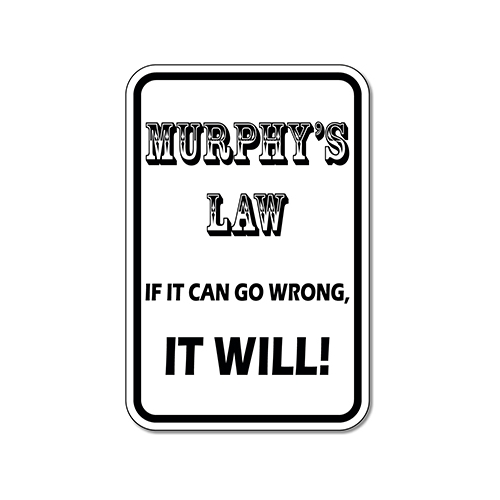
Murphy’s Law is all about “Life’s Many Disasters.” Some disasters can be handled by “throwing money at the problem.” Such things as unexpected car repairs fall under this category. Really, any problem where you are going to have to hire someone else to fix it falls in this category. This is why banks, advisors and so many others recommend that you keep a minimum of 3 months expenses in an emergency fund.
Not every possible problem can be solved this way. If you’ve lost your job, you need to know that you can feed your family until you get a new job. There are other problems that are along the same lines. Preppers call this situation “WSHTF” (When S*** Hits The Fan).
It wasn’t until I joined the military that I heard of Murphy’s Law. Somehow, it just resonated with me. Think about it for a minute. No matter how much planning you do, there is always something that can go wrong at the last minute. So why not prepare for that?
How can I plan for a disaster?
Identify the possible disasters that can befall your family. Such as:
Household emergencies
Medical emergency
Transportation emergencies
Environmental emergency.
List the most likely problems:
Household – Loss of Income, Major Appliance failures, Water Damage, etc.
Medical – Hospitalization, Long term Disability
Transportation – Car Repairs, Car Wrecks, etc.
Environmental – Weather related, Acts of God, etc.
Make a written plan for how you can handle these problems!
Why should I write it down?
Really? You need to ask that one? If you have suggestions for solutions written down, then this information is available to others in the house. Now to be honest, that list could easily be on your phone or computer.
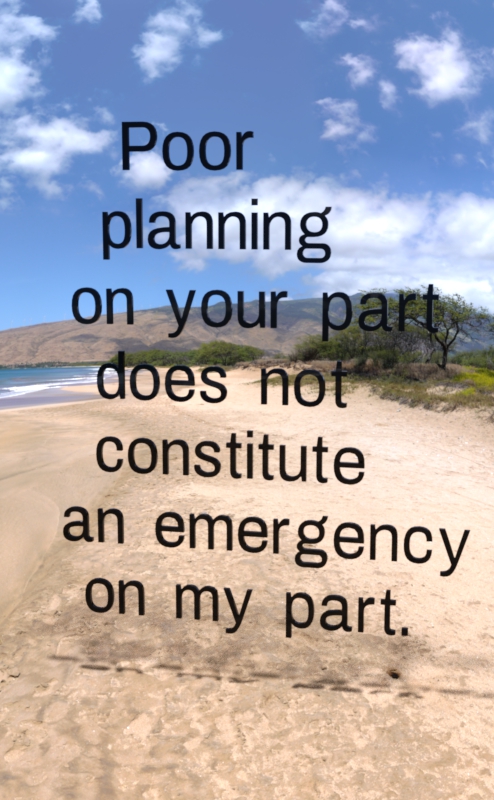
This little quote is something I first noticed on the walls of one of my husband’s duty stations. And it is, to a certain extent, true. The people around you in a disaster situation already have their own problems. They may not have time to stop and help you.
What do I need to write down?
Sigh. Where to find this information! Surely you have preferred repair people for your house or car. Include the contact information for these people on your list! List where to find your medical insurance or Living Will information! In the middle of an emergency your family could very easily be rattled. Knowing where exactly to find this information gives them one less thing to stress over.
Environmental Emergency
This deserves a section all its own. This is the one area where all you can do is to “roll with the punches.” Folks, I live in Florida. Down here it’s not a question of whether we’ll get hit with a hurricane or flood, it’s a question of “when we’ll get hit with either!”
If you think about it, you most likely have similar situations occur where you live. People in the northern states know it’s going to snow; the only question is how much it will snow. People in the Midwest know that tornadoes are a real threat. I could go on if you need me too!
What can I do to prepare?
At this point, I’m going to use my situation as an example. Growing up in PA, the biggest threat I can remember was the possibility of getting snowed in. The power rarely went off (that I can remember) so a freezer full of food generally covered the problem.
It wasn’t until Hurricane Irma hit in 2017 that I realized that same solution wouldn’t work for every location. We lost power for 6 days. When the power was restored, I started checking the food in the freezer. I had to throw away 1/2 the contents of my freezer before I got to food that was still frozen. Moral of the story is if you don’t want to eat nothing but hot dogs and hamburgers, have some things that don’t need refrigeration available!
Before you start buying!
There is always the temptation to just buy those prepackaged Emergency Meal kits. But before you grab one of those, think about what your family likes to eat. If your family likes to eat what’s in those kits, you’re good to go. If not, then take a look at what they do like. What can, with a little bit of work, still work for you. Then take a look at your recipes. Are there some there that can be set up in advance?
For example, my husband and I like mac and cheese. There are some powdered cheese blends on the market that can be used. I purchased a can to try now. He hasn’t noticed a difference so that is one thing I can use. Vegetable soup is another meal that can be set up. Grab as small a container of the freeze dried or dehydrated mixes as you can find. Make some and let your family taste it. If they still like it, put a larger can on the shelf.
Hurricane season doesn’t start until May so I have until then to decide on what meals I can make if power goes out. I do have a flat top grill that I can cook on so that opens up quite a few options. Believe or not, I can still sit a pot on that to heat something up.
In Conclusion
You have more options if you plan in advance. I don’t know what your situation is, but you do. Work with it! If you expect something to go wrong, you are prepared for when it does. Nothing good comes out of panicking because you forgot to prepare.
We all have days when it seems like we just don’t have the time to make a good meal for our families. We want to be able to serve them nourishing food that they like, but time gets in the way. We come home from work tired, or it’s later than normal when we get home. Whatever the reason is, we are in a bit of a time crunch. Saving you time in your kitchen for these reasons is why I started my “Prep” series.
If you use little bits of time to prepare your ingredients, Meal Prep, then when it comes to cooking, that work is already done for you. If you gather needed ingredients together in advance, Recipe Prep, then again, you’ve already got some of the work for that night’s meal done. If you’ve taken the time to organize and stock your pantry in advance, Pantry Prep, then you can simply gather what you need to make your family a satisfying meal. It all works together!
I don’t know how much storage space you have, if you have a big freezer or anything like that. I can only tell you what works for me, and give you ideas for what may work for you. Since I live in a house trailer, my guiding principle is “Where am I going to store it!”
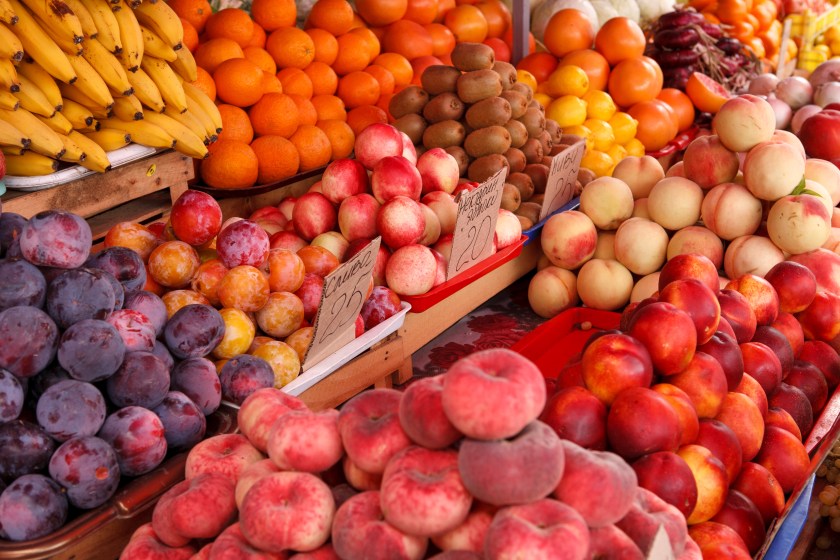
If you look very carefully at your family’s favorite recipes, you will see that there are a number of ingredients that are common to them. Off the top of my head, I can think of onions, carrots, celery, and bell peppers. Now, they may not always be prepared the same way. Onions may be diced, sliced pole to pole, or sliced crosswise. Same for the others. So make sure you freeze some of each type.
This is where things get interesting! Depending on how you plan to cook your recipe, you can add all the ingredients into one-gallon sized bag or use a large bag to gather all the smaller ingredient bags together. Either way, you can find all types of recipes called either “Dump and Go”, “Fix It and Forget It” or “Freezer Meals” that are available!
Before you jump in and start gathering ingredients, take a moment to actually try the recipe first! If you know of any recipes that you already have that could benefit from having everything already prepared, try them first. That way you keep familiar foods in front of your family.
For example, I bought this book on sale recently. The recipes all look good, and I’ll probably try a few more. But I was cautious and made one for my husband and myself. Halfway through eating, we both agreed that it didn’t have much flavor. So try it before you spend the time to prepare multiple meals.
To me, Pantry Prep is where the magic happens. It’s amazing how simple it can be to create something that tastes great from just a few ingredients that are in your pantry. I got started on this idea when I came across a recipe from Allrecipes called “Shipwreck Casserole.” From there it sort of snowballed. LOL!
Pantry prep can also include a lot of the ingredients that Food Preppers use. I’ll let you decide what you want to use.
Home Canning and Dehydration
I would be remiss if I didn’t mention these two methods of food storage.
I’m from Pennsylvania, and I know home canning. It’s what I grew up with. It was the way my mother would stretch a meal to include unexpected guests. As you can see, I’ve started a Pinterest board to gather all these ideas together.
These are the kind of things you want to have on hand if the area you live in is regularly threatened by power outages. It doesn’t matter if it’s because of rain, (I live in Florida), snow (I’m looking at you there in the northern states), or even because of tornadoes (Midwest!). If the power goes out, you need a way to feed your family.
After the Pandemic that shut down the world, I would also take a look at what you would need to keep your family going if something like that happened again. FEMA recommends having a 3-day supply of food on hand for emergencies. If something like that happens again, 3 days is not enough to cover. I started canning again after Hurricane Irma knocked out power at my home for a week.
One last thing….
Don’t feel like you have to stick to just one way of food prep. In every book on freezer meals that I looked at, all of them required you to thaw the food first. If you’ve thrown everything in a gallon freezer bag, that’s a big lump of frozen food! I can tell you from experience, it won’t thaw in your refrigerator overnight! You need it thawed so that it will pass through the danger zone of 40–140°F (4–60°C) as quickly as possible.
Now, I don’t know about you, but the array of ingredients shown above would make the start of a very fine stew. There’s onions, carrots, celery, peppers, and potatoes. Add a protein and pop in the slow cooker. Packaged like this, I dare say all of them would thaw nicely in the fridge overnight.
Here’s another thought for you. This lovely lady has an entire series on canning different kinds of foods. They all start out with the same three words, “I Can Can.” In this book, on page 34, she gives directions for a Boxless Hamburger Helper that uses canned beans, canned ground beef, and a Mason jar with seasonings and macaroni. I’ve tried it, it’s good. To me, this is a great example of mixing up your food prep. I used frozen beef instead of canned, but it still all works together. Step out of your comfort zone and try something different!







 Book Reviews by the Reluctant Retiree