

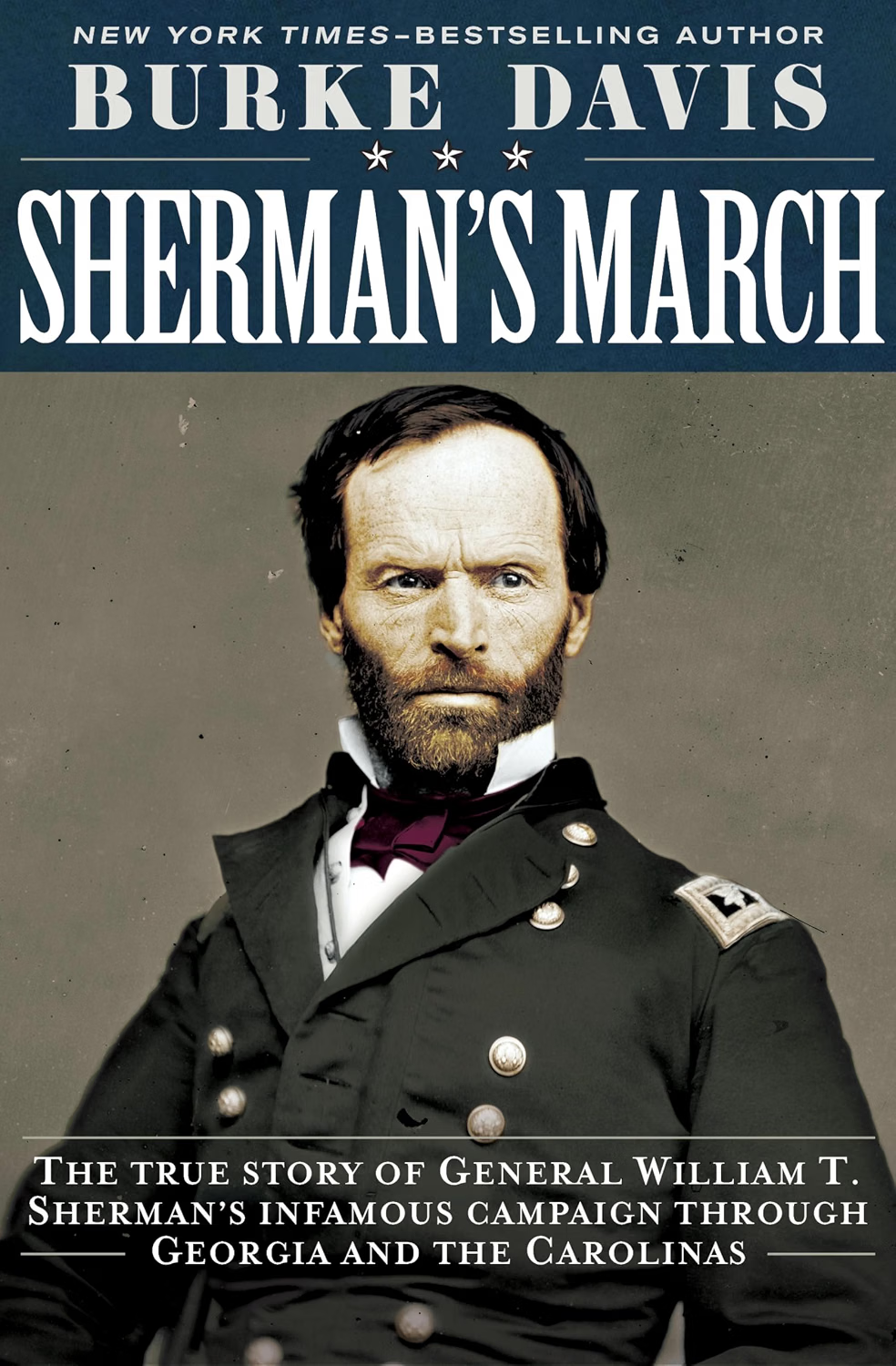
A New York Times–bestselling author’s account of the devastating military campaign that broke the Confederacy’s back in the last months of the Civil War.
In November 1864, just days after the reelection of President Abraham Lincoln, Gen. William T. Sherman vowed to “make Georgia howl.” The hero of Shiloh and his 65,000 Federal troops destroyed the great city of Atlanta, captured Savannah, and cut a wide swath of destruction through Georgia and the Carolinas on their way to Virginia. A scorched-earth campaign that continues to haunt the Southern imagination, Sherman’s “March to the Sea” and ensuing drive north was a crucial turning point in the War between the States.
Weaving together hundreds of eyewitness accounts, bestselling author Burke Davis tells the story of this infamous episode from the perspective of the Union soldiers and the Confederate men and women who stood in their path. Eloquent, heartrending, and vastly informative, Sherman’s March brilliantly examines one of the most polarizing figures in American military history and offers priceless insights into the enduring legacy of the Civil War.
Editorial Reviews
Review
“A well-researched narrative. It captures the mood of the soldiers, and it graphically depicts the suffering that the army inflicted on those unfortunate persons who happened to be in its path.”
— Library Journal
From the Trade Paperback edition.
From the Publisher
9 1.5-hour cassettes
From the Inside Flap
rch is the vivid narrative of General William T. Sherman’s devastating sweep through Georgia and the Carolinas in the closing days of the Civil War. Weaving together hundreds of eyewitness stories, Burke Davis graphically brings to life the dramatic experiences of the 65,000 Federal troops who plundered their way through the South and those of the anguished — and often defiant — Confederate women and men who sought to protect themselves and their family treasures, usually in vain. Dominating these events is the general himself — “Uncle Billy” to his troops, the devil incarnate to the Southerners he encountered.
“What gives this narrative its unusual richness is the author’s collation of hundreds of eyewitness accounts…The actions are described in the words, often picturesque and often eloquent, of those who were there, either as participants — Union soldiers, Confederate soldiers — in the fighting and destruction or as victims of Sherman’s frank vow to ‘make Georgia
From the Back Cover
Sherman’s March is the vivid narrative of General William T. Sherman’s devastating sweep through Georgia and the Carolinas in the closing days of the Civil War. Weaving together hundreds of eyewitness stories, Burke Davis graphically brings to life the dramatic experiences of the 65,000 Federal troops who plundered their way through the South and those of the anguished — and often defiant — Confederate women and men who sought to protect themselves and their family treasures, usually in vain. Dominating these events is the general himself — “Uncle Billy” to his troops, the devil incarnate to the Southerners he encountered.
“What gives this narrative its unusual richness is the author’s collation of hundreds of eyewitness accounts…The actions are described in the words, often picturesque and often eloquent, of those who were there, either as participants — Union soldiers, Confederate soldiers — in the fighting and destruction or as victims of Sherman’s frank vow to ‘make Georgia howl.’ Mr. Davis intercuts these scenes with closeups of the chief actors in this nightmarish drama, and he also manages to give us a coherent historical account of the whole episode. A powerful illustration of the proposition put forth in Sherman’s most famous remark.” — The New Yorker
About the Author
Burke Davis (1913–2006) was an American author and journalist best known for his narrative histories of the Civil War, including To Appomattox: Nine April Days, 1865 (1959), Sherman’s March (1980), and The Last Surrender (1985). His acclaimed biographies of military and political figures include They Called Him Stonewall (1954), Gray Fox: Robert E. Lee and the Civil War (1956), Marine!: The Life of Chesty Puller (1962), and Old Hickory: A Life of Andrew Jackson (1977). A longtime special projects writer for Colonial Williamsburg, Davis also published many works of historical nonfiction for young readers. His numerous honors include the Mayflower Cup, the North Carolina Award for Literature, and election to the North Carolina Journalism Hall of Fame and the North Carolina Literary Hall of Fame.
Share this:

Discover more from Book Reviews by the Reluctant Retiree
Subscribe to get the latest posts sent to your email.
